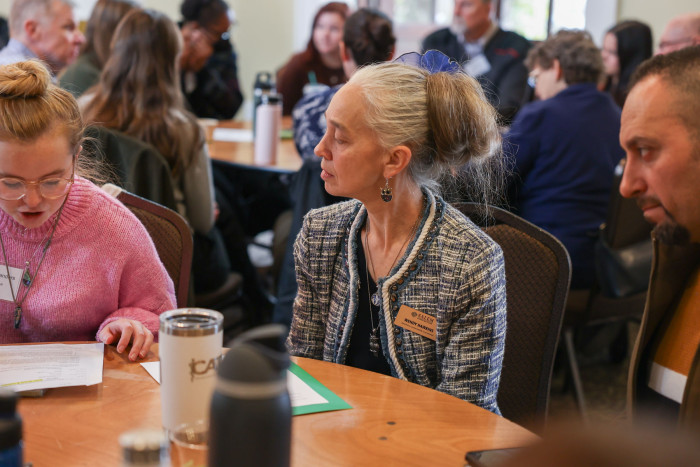
PEA Green Economy Intern Caila Cater-Edwards interviews Wendy Hawkins, the first Operations Sustainability Coordinator at Salem Academy and College, and a dedicated member of PEA’s Green Business Network. Wendy shares her unique journey from the campus mail room to sustainability leadership, highlighting her work on innovative waste reduction and the revitalization of local brownfields.
CCE: Wendy Hawkins, I am thrilled to have a conversation with you! The team has spoken highly of you and the goals you all have at Salem College, especially being a member of the Green Business Network. Before we get into the initiatives you all are working on, I would love for you to tell the readers a little bit about yourself and journey to Operations Sustainability Coordinator at Salem College.
Your path to sustainability wasn't seemingly exactly direct, beginning your career at Salem College in the mail room; was there a defining moment that pivoted your focus toward environmental science, or did this passion evolve more gradually over time?
WH: I have always loved the outdoors and everything in it, as far back as I can remember, but my search for a job in this field was inspired by my decade of volunteer work and service on the board of Forsyth Audubon, our local chapter of the National Audubon Society. I was initially drawn to this group by my absolute enjoyment and obsession with observing and identifying every bird I came across. Then they taught me about the many threats to my feathered friends and how we could work together on conserving, creating, and advocating for healthy habitat that they (and we) need. When my husband Randy passed away in 2017, I decided to look for work in an environmental field, but everything I was nearly qualified for required a degree that I did not have. That’s when I found a great part-time position in the Mail Center at Salem, which was already a special institution where my husband had worked a few semesters as a piano accompanist for some of the college choirs. As I got to know Salem, I learned that I could also go back to school and earn that degree that I didn’t have. All of my previous decades-old credits transferred, and I finished my degree in Environmental Studies: Conservation Ecology in 2022. Following that, Salem developed their first-ever sustainability coordinator position, and I successfully applied. So, here I am, living out my dream job with the best group of people I could possibly be working with and engaging with great students from all over the US and the world!
CCE: Such a beautiful journey, Wendy. Thank you for sharing that with us! A close friend of mine has a strong love for bird watching, so I may need to send them your way to get more information on the National Audubon Society. I also really admire how you were able to transition a hobby and passion into a career. A wonderful testament that it is never too late to further your education, change or explore other paths. Thank you again for that.
You mentioned that your current role as the Sustainability Coordinator is new, with you being the first to hold said position. Can you share a little more about what exactly this role entails? How has the role evolved over time?
WH: Sustainability can be a wide umbrella, evolving and adapting based on what is most urgent or most attainable for an organization at the time. Although I am currently a “department of one,” institutional sustainability is essential and involves everyone. So, my job is to gather information, evaluate impacts, bring awareness, provide resources, and facilitate conscious actions that engage everyone in the process. Being an institution of higher education provides a unique opportunity to impact a revolving door of students from around the globe, instilling lifelong sustainable practices and concepts. Some specific responsibilities of my position include evaluating our practices, consumption, waste, and habitat quality -- helping us determine whether they are healthy and sustainable for the indefinite future. This involves collecting and analyzing data (such as utility usage and water runoff quality), then identifying where we could better conserve and protect natural and financial resources. Next steps include reporting these findings, and engaging applicable people in creating and implementing a better plan.
All plans are formulated against the “triple bottom line:” equal consideration of environmental, economic, and social impacts. We need to understand how our ecosystem system functions (or should function) and our role in it, viewing ourselves as part of the wildlife, not separate from it. Humans have a lot of power, and with that comes a lot of responsibility.
Social components of my job include engaging students, faculty, and staff in awareness, education, resources, and activities that effect change, as needed. Organizing events (such as cleanups, including our adopted section of Salem Creek), environmentally focused pop-up tables, campus nature walks, classroom talks, designing sustainability-related semester student projects, advising the college ECO Club, building relationships with people in all departments, and collaborating with local organizations outside of campus are all important aspects of my position. To ensure our efforts are truly sustainable, plans and actions must be regularly re-evaluated and adjusted for the future.
Working in sustainability is a lifetime learning experience! I have learned (and continue to learn) a lot from my supervisor, Tina, who joined our campus in June of 2023, and came with a wealth of college campus sustainability experience. I also enjoy the invaluable support and resources from the PEA Green Business Network staff and members!
CCE: This sounds amazing Wendy! Definitely sounds like you have your hands full but it seems that you are handling it all like a champion. Having served as a Sustainability Ambassador at App State, I really resonated with your point about the 'wide umbrella' of this work—it’s so vital to keep students engaged with their environment and waste impact.
In chatting with the team, the grant for a potential new recreation area and the recycling/composting projects caught my attention. I’d love to hear more about your plans for those and how you see them fitting into the college's 'triple bottom line' goals!
WH: I would be happy to share a little more about these projects.
Athletics Field: We have applied for an EPA Community-wide Brownfield Assessment Grant in order to revitalize the 7 acres where our softball field and older soccer fields sit. This parcel is a brownfield because it was previously a landfill for the City of Winston-Salem in the 1940s-60s. Although measures in the past created a safe athletics field space when Salem bought the property a few decades ago, settling of the ground continues and is now in need of revitalization in order to be utilized to its full potential. Creating a new athletics facility, and engaging community partners in the process would not only benefit Salem’s athletes, but provide healthy outdoor activity opportunities and social connection for the surrounding community. This field is geographically centered in low-income, disadvantaged, environmental justice communities of concern. The economic benefits of bettering community health include reduced medical expenses, missed work days, and injuries. Outdoor activities are also essential for good mental and physical health (e.g. reducing stress, improving strength and circulation)
Recycling/Composting: The goal with recycling and composting is keeping waste out of the landfill, but one of my sustainability goals is to educate and empower campus members to reduce waste and reuse items as much as possible before recycling or composting. We pay for separate third-party recycling and composting services, since there is no city curbside service for businesses our size.
Recycling: The biggest recycling transformation coming up will be custom made, uniform, dual-bin recycling/trash systems. A local carpenter, who actually has a global clientele, will be crafting our bins out of sustainably sourced bamboo and an alternative recycled, easily cleanable material for the top.
Composting: Composting is important because it prevents a lot of toxic methane (one of the most potent greenhouse gases) production in landfills. Above-ground, hot, aerobic composting turns food waste into organic compost that can enrich the soil for farmers. This method does not release toxins into the air. We currently compost through our dining hall, which uses the food waste collection bins that are picked up twice a week by Triad Compost Service. There are NO trash or recycling bins in the dining hall. All post-consumer dishes, food waste, paper napkins, etc., are placed on a rotating dish return. Then paper waste, food scraps, recyclables, and trash are separated from the dishes and sorted appropriately by the kitchen crew behind the scenes. Triad Compost Service provides the food waste in pounds each month, so I chart that data and compare each month across years. I also take occasional photos of what is in the bins to gather data on pre-consumer vs post-consumer waste. Our dining service has started donating food to a local food bank, but the food bank is not part of our dining budget and should still be only “plan B” for good, unused food. One challenge is kitchen staff turnover, training, and diligence in sorting and depositing waste correctly, instead of just throwing everything in the regular trash, but I always have hope for improving consistency.
CCE: Thanks so much for your leadership, Wendy.