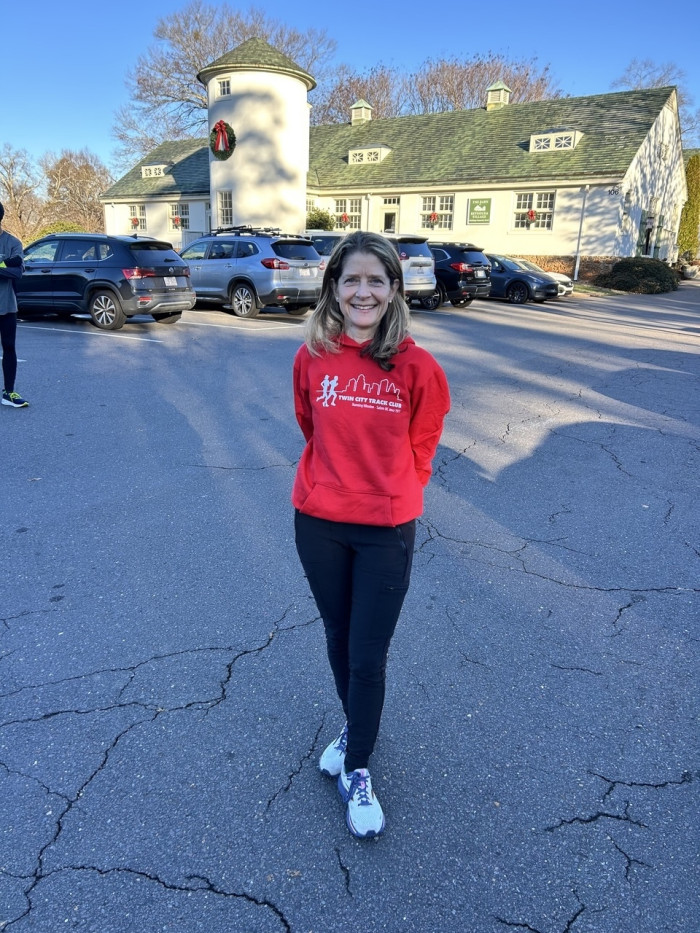
Richard Sebastian, Green Economy Program Coordinator at PEA, interviewing Marlena Westcott, a volunteer for new Green Business Network member Twin City Track Club.
Richard Sebastian (RS), PEA: Thanks for coming today. I know you through your work at Twin City Track Club (TCTC), but I confess I don’t know your official role there. Are you a volunteer, staff–do you have a title?
Marlena Westcott (MW): I am a volunteer. But I have given myself the unofficial title of After Race Festivities Coordinator [laughs].
RS: Ha, OK. Can you tell me a bit about the history of TCTC and how you got involved with the organization?
MW: TCTC is the oldest track club in the area– it was established 50 years ago. I discovered TCTC in 2017 through one of their meetup runs–TCTC organizes various runs around town that they post online, or on the running app Strava–many years after my partner, Carl, and I moved here from Pennsylvania in 1997 for work. I was a runner in graduate school in Philadelphia, and then life happened. I moved to Winston-Salem, had some kids, and fell out of the running community for a while. But eventually I discovered these run meetups where I met many of the people that I'm still really good friends with now.
The engine that makes the organization run is its volunteers, and TCTC encourages members to volunteer at their races. I started volunteering for the Beat the Heat (BTH) 5K, the largest race that TCTC hosts every year–it attracts up to 1000 runners every summer. So that's basically how I started volunteering with TCTC.
RS: TCTC joined PEA’s Green Business Network primarily to get support making the BTH 5K more sustainable. Can you describe how you, in your volunteer role at TCTC, became interested in looking for ways for the race to have less of an impact on the climate. How did that evolve?
MW: That's easy. As a BTH volunteer, particularly after several years working the post-race food and drink area, I noticed that the trash that the race was generating was all going to the landfill. There was no dedicated effort to sort it into recyclables, compost, and trash for the landfill. I discovered some members had tried this in the past, but the effort really requires dedicated leadership–one or two people passionate about taking it on. I looked at what the track club had done previously and realized we could do better if we partnered with an organization that knows something about sustainability. I've been a member of the PEA for years and got connected with the GBN to see how you could help us take a serious look at our environmental impact. We really wanted to reduce our landfill as much as possible.
RS: What are some of the actions you’ve been taking since becoming a member?
MW: We looked at what some of the bigger run clubs in DC and Atlanta were doing and saw that they're already doing this pretty well. Those clubs have a lot more runners and volunteers to support their zero waste goals. I volunteered for the Piedmont Earth Day Fair this year, to learn firsthand how PEA does a zero waste event. It was really fun, by the way. And so, like at Earth Day Fair, we're gonna have waste sorting stations staffed by volunteers. Also, good signage directing people to where to put their food and drink waste, and then community partners to help us execute our plan.
RS: Besides PEA, who are some of the other community partners helping you with this effort?
MW: The City of Winston-Salem will be providing recycle bins. Believe it or not, there haven't been recycle bins there even though it's a city facility. No one ever asked. Triad Compost Service, a fellow Green Business Network member, will be providing compost bins and a way to measure how much compost we generate. We will have some waste going to the landfill, but our goal, with the help of our partners, is to significantly reduce the amount compared to previous years.
We’ve also partnered with UNIFI, an international company based here in the Triad that converts plastic bottles into a synthetic resin called REPREVE, used to make clothing. This year UNIFI will recycle our plastic bottles of water into this resin, which we are really excited about. Another partner, Sneakers for Good, helps keep sneakers out of the landfill. During BTH, runners can bring their gently used athletic shoes and Sneakers for Good will either recycle them or donate them to organizations that need them. The first 100 runners who donate a pair of sneakers will get a free pair of UNIFI socks. Ace Hardware Northwest donated some items to help us at the waste stations. And of course, PEA is helping us with our Zero Waste plan and with the metrics to measure our impact.
RS: I know that race hasn't happened yet but have you gotten a sense of the level of enthusiasm for this? Are other folks getting behind it and enthusiastic?
MW: We’re highlighting our sustainability efforts on the TCTC website. If you go to sign up, you will see a sustainability tab. All of our food vendors are very enthusiastic about it and are bringing compostable serviceware and containers, as much as they can. I know the running community is pretty excited about it, too. Runners are outside a lot, and appreciate the natural world, and generally support reducing plastic pollution, carbon emissions, etc. I think that they will be in support of making this successful.
RS: Besides Beat the Heat's Zero Waste efforts, TCTC is also making an impact in other ways, too. Can you tell us a little about those efforts?
MW: Sure! TCTC’s mission is to not only promote health and wellness in the community through running, but also give back to the community through donations to local charities. Every year, BTH selects two charities to receive the proceeds from the race. This year they are The Community Care Clinic, a free medical clinic in town for the uninsured, and Ainsley's Angels, a fitness group devoted to promoting inclusiveness in fitness for the disabled members of our community. Additionally, partner nonprofits can organize teams and team members can fundraise, asking friends and neighbors to donate.
RS: Yes, PEA has a BTH team this year! Besides BTH, are there other races TCTC hosts?
MW: BTH is the largest, most well known race. But there are a number of other races that TCTC sponsors. So we just had our Ultimate Runner in June. We have a Five Dollar 5K race the second Tuesday of every month from April through September at Jameson Park. We have Hobby Trails to You run, a trail race in Hobby Park. You can go to the TCTC website or Facebook page to see all of the races. Also, become a member. It's inexpensive, and you get race discounts. You also get the community: running is a real community, and a great way to make friends. There are some ways to exercise where you can't really chat, you know, like swimming...
RS: I'm a swimmer. You’re right–it's hard to be social.
MW: You can chat when you get to the wall, I guess [laughs]. But running is a great way to get to know people while also improving your physical and mental health.
RS: Besides your Zero Waste goals for BTH, what are some of TCTC’s longer-term sustainability goals?
MW: Our Green Business Network membership has really been focused on BTH because it was an obvious place to start to address the waste we were generating. The experience is really going to educate us on the pace at which we'll be able to do this. But our goal is to build sustainability into all of our races and events, and eventually into our TCTC bylaws.
There's also a national organization called the Council for Responsible Sport (CRS) that a lot of larger run clubs are a part of, that helps groups measure and manage the social and environmental impacts of events like footraces, and certifies groups when they meet certain standards. Eventually, we’d like to achieve CRS certification.
RS: Is a desired outcome also to influence other local sporting groups or events? Do you think your zero-waste goals are gonna ripple out to different communities?
MW: We hope so. TCTC is a very community focused organization, and we see this as a way to show the community how a big event like this race can and should be sustainable. We hope it will influence all of the runners, running groups, their friends and families coming to watch, our sponsors, and businesses in the community to think about what they can do to be more sustainable.
RS: Can people still sign up?
MW: Yes, you can still sign up, even up until race day. You can sign up as an individual runner or join a team, like the PEA team. They can also sign up to volunteer. Our Green Team volunteers will be managing the waste sorting during and after the race. We welcome volunteers, runners, and even non-runners: it’s a really fun event.
RS: Thanks, Marlena.
MW: Thank you. This was great.
Beat the Heat 5K will be held at Winston-Salem Fairgrounds on July 18, 2026 at 6:00pm